Showing posts with label Guatemala. Show all posts

Wednesday, 17 May 2023

No:7 Our sail to and time in Havana, Cuba

๐Ÿ‘‰Our time in Cuba 


Our sail to Havana was the longest sail to date that Mel and I had ever done. Previously our longest sail had been 4 days from the Cayman Islands to Guatemala, back in June 2018.

We knew that a major part of the sail to Havana would require us to motor as we were easting out of the Bay of Honduras, and the prevailing winds were coming from the east. We never enjoy putting the engine on but there are times when it is unavoidable.

It takes us a while to settle into a routine so our first night of sailing is always a bit unpredictable and lacking in sleep but as the following days progress, we start getting into a routine when one is on watch while the other rests or sleeps. This sail, we decided to see if we could each be on a longer watch – 6 hours at a time.

This was our schedule: 5.30pm – dinner (I usually have prepared some frozen dishes, like what I do at home in Perth – when cooking mince, I make a huge quantity for a few meals and then freeze it.)

While Mel is washing up, I shower – the boat is on Auto pilot, we have an AIS (Automated Identification System) – this alerts us if any ship or sailing vessel (with AIS) is within 2 nautical miles of us. However, despite having this, we still do a 360 degree scan every 15 – 20minutes, regardless.

I then go on watch while Mel showers and has a snooze until 8.00/8.30pm. If we are in the cockpit on our own, we always wear our life jackets and at night, we attach ourselves to the safety cleats in the cockpit.

8.00pm – 2.00am it is my sleep time, while Mel is on watch. He sets his watch alarm to go off every 20mins so he can shut his eyes for a while.

Sometimes, we sleep in the cockpit while other times, we sleep down in the main saloon/lounge/living area. Our seating area can change into a double bed. It is in the centre of the boat so is quite stable and comfortable to sleep, although I struggle with the glare of the lights on the main switch board and the AIS, so I wear an eye mask which certainly helps.

2.00 – 6/7.00am it is Mel’s sleep time although if I am in doubt of anything, I wake Mel up.

A few people have asked what I do while on watch. Well, I usually read. I have found reading a book on my Kindle so much better than reading a paper book, as I can increase the size of the font. I found through a bad experience that if I read a paper book while sailing, I tend to become quite seasick. This sail, I read two books (Ken Follet) and started another book. I can’t do any hand sewing while we are sailing as it makes me seasick having to concentrate on such a small, precise area.

During the day, as mentioned earlier, we take turns to sleep and to be on watch.

For our second, third, and fourth days, the wind was a beam reach – the wind was coming from the east and we were sailing north, so the wind was coming from our side, our starboard/right side, which made for comfortable sailing.


We had a little bird visit us on the second day. It looked quite tired and seemed keen to get out of the wind and so hid behind our dodger (a windscreen).  A few times, when we were not watching the little bird, it flew into the cabin and made itself quite comfortable on one of the shelves. We shoed it outside and it seemed happy to have somewhere to rest.

After about half an hour, it flew away across the water. We were not sure where it was heading but at the same time the following day, we think the same bird paid us a visit and once again made its way into the cabin.

We didn’t see it on our fourth day of sailing although a bird similar to the little one, flew by the boat early on our fifth morning.

While we were sailing, we saw and passed quite a few cruise ships, mainly at night, and container ships. They look so big out in the ocean, so we usually make sure we are at least 2 -3 nautical miles away from them.

The night of our fourth day of sailing we reached the western point of Cuba and knew as we slowly made our way around Cuba’s NW coastline, heading eastwards the wind would die and become easterly, forcing us to put the engine on if we wanted to maintain our average of 5 nmiles an hour.

We eventually arrived at the safe water mark outside Marina Hemingway early Sunday morning and waited for the Marina and Customs to respond to our call for permission to enter the channel and marina. We went round in circles, admiring the skyline of Havana.

After waiting for quite a while and going round in circles, we just took it upon ourselves to enter the marina, as nobody responded to our request and we could end up waiting for ages.

We were grateful for the fact that the depth of the channel and marina were clearly shown on our navigational charts as our depth sounder was not working.

We tied up at the Customs and Immigration dock as we knew this was the correct protocol and procedure. The Officials were all very young and helpful but all I can say is ‘Sheltered employment’. We had the customs, immigration and health official – who changed us each $US35 just to have our temperature taken, another health official making sure we didn’t have anything illegal like fresh fruits and vegetables.


After filling out triplicate forms for each official, we were allowed to make our way to the marina, which was literally around the corner. Once we were all tied up and secure, we had the same amount of people come on board with the same type and number of forms to fill in. We were advised that we had to apply for a visa. This was new (compared to 2018) and of course just a money-making exercise.

The Marina Captain was a gentle giant and said we had access to water and electricity. Great as we could wash down Passages after 5 days in salty water. Mel proceeded to wash her down, using quite a bit of water – Later we learnt that the marina has two large water tanks, and the water is brought into the marina. If we wanted water from the water tap at our berth, we would have to ask for the water to be ‘switched on’. We were happy to be on land so settled down for the afternoon, going for our usual walk to explore the place.

I will not go into too much detail except to say that we found the whole experience in Cuba quite stressful. We knew from experience (2018) that there were shortages – that’s okay as we had enough food on board, but the lack of Wi-Fi and Internet access was extremely frustrating. In 2018, we could visit the local hotel, pay for a log in/sim card and all was fine, even though the Wi-Fi was slow.

We need the Internet to check the weather. It is our lifeline. Yes, thankfully there are new developments in this area (Starlink, etc), but these are still very new and extremely expensive. Who knows what Elon Musk will do in the next year or two with SpaceX – all very exciting for us yachties.


Marina Hemingway is about a 30 min/ 25km drive outside of the city centre. We knew there was public transport but the people at the marina were eager for us to use the ‘taxi’ service into Havana. We tried to find out about the bus system but hit a brick wall all the time. Not knowing enough Spanish was also an issue. We can get by with the Spanish we know but we are by no means fluent and confident to follow a long and involved conversation and discussion. Translator on our phones is amazing but you require the internet/Wi-Fi.

We tried to find out some information from the two hotels on the marina. It was so sad to see, everything was like a ghost town. This huge development with apartments, restaurants, shops – a lovely community but nothing was open. It did have some interesting and creative statues around the place – see in video. If it was open like one of the hotels (the other was closed) there was a skeleton staff. We asked for Wi-Fi connection. We needed to go into town/the city to get a card. We asked how we could get into Havana city centre, take a taxi. The taxi ride would cost us $25US one way and even then, it was dependent on fuel. I said many times to Mel, this so reminded me of my university days, when I would go home to Harare, Zimbabwe for the holidays and spend most of my time in petrol queues, helping my parents to get some petrol that would allow them to get to work the following day.


We noticed that many people now had electric bikes, scooters which is the way to go, especially if there are fuel shortages, however at the marina, the electricity was quite inconsistent.

We relented and arranged for the ‘taxi service’ to take us into the city centre on the Tuesday so at least we could organise some internet connection. Our taxi was an old car which I think was older than Mel and myself. ๐Ÿ˜Š

It was lovely to be back in the city centre of Havana as it is suc


h a mixture of old, new, modern, and outdated. We were approached by many people to exchange US$ into the local currency.

We noticed that some places had had a revamp, while others had either closed their doors or the building was being torn down. We knew from our time in 2018, that squatters’ rights and privileges dominated the whole city centre – basically if squatters were staying in the building that is in the prime real estate area, tough. They could stay there. However, we noticed – remember this is our perception, that the city centre is being redeveloped and ‘cleaned up’. Unfortunately, our favourite pastry shop was no longer open.

Please remember that what I write is our observations and opinions…… There is certainly money to be made in Cuba although we have often said; “who is making the money and how is it being distributed”. There were certainly some very wealthy local people around.


Anyway, we managed to find the mobile phone / Wi-Fi shop so by mid-morning, we were feeling a bit less stressed as we had downloaded the weather and were able to respond to some messages that were on Mel’s phone.

We saw that the weather looked good to cross over the 90 nmiles to Key West, the following day, Wednesday and that the weather would progressively get worse as the week progressed, only improving a week later – Tuesday. We made the decision to leave Cuba on Wednesday arriving at Key West, Thursday morning. We were desperate to get to the States, as we wanted to start working on all the modifications and upgrades, Passages needed and to instal all the new goodies we had bought at the Miami boat show in February.

After enjoying a lovely afternoon walking around Havana, we caught our taxi back to the marina and advised the necessary authorities about our decision to leave Cuba. There is still a lack of toilet seats and toilet paper in Cuba – please refer to my previous blog entry about our time in Cuba, June 2018 – after this blog entry.

Wednesday morning arrived and we thought we would check the weather as we usually do before we set sail. If the weather is still good to sail, then off we go, if it is not, we stay put. Once again, the Wi-Fi at the marina was not working despite us having bought the necessary cards, so we thought bugger this, we ‘re still going.

Well, there were moments over the following 24 hours we regretted our decision to set sail without checking the weather as we had the worst ever sail!

Not many people like to sail close hauled, that is when you are sailing very close to the wind and the boat is healing a lot. I dislike it immensely, however, after this sail, I am cured of being scared that the boat will ‘tip’ over. At midnight, Mel even said ‘maybe we should sell Passages!’ IT WAS THAT BAD!!! We hardly slept! AND it was EXTREMELY uncomfortable.

It was awful because it was like a washing machine, a situation no sailor wants to be in. Wind against current as it can be quite dangerous at times.

When we were halfway – literally – 45 nmiles, we received a call on our radio from the US Coast guard, requesting details about us and the boat and where we were heading. It was a slight comfort to know that we were being watched by the US Coast Guard.

What should have taken 18 hours, took us almost 30 hours! I nearly hugged the girl at the fuel dock of the marina we had booked into at Stock Island, Key West, when we tied Passages and switched the engine off.

As we sailed closer to the US coastline, we informed the US Coast Guard and Customs and Border Protection about our intentions and where we were going. We were told under no circumstances, were we allowed to step onto land but to stay on the boat until some officers from Customs and Border Protection had visited us at the marina’s fuel dock. We had arranged to meet them at the fuel dock at a time we knew we would be there, so we didn’t have to wait very long.


By 6.00pm, Passages was all secure in a pen at the marina, Mel and I had a wonderful shower, a bite to eat and we slept for over 12 hours as we were exhausted.

The following day, Friday, we made our way to Key West Airport, to the Custom and Immigrations Department to complete the necessary paperwork for entrance into the USA. It went much smoother than anticipated.

Our goal now is to have Passages taken out of the water for a few days while the new prop, depth sounder, and windvane are put on. This will be taking place at 3D Boatyard which is right next door to where we are staying at the marina. We know many of our packages are waiting for us at 3D Boatyard, so..., until the next update of our adventure, take care and enjoy whatever you are doing.

Bye for now. 

Mel and Caryn

sv Passages

If you want to see where we currently are – press on the "Latest Location" link at the bottom left of the page. This may not be accurate and is dependent on sites with access to AIS (automatic identification system).

Wednesday, 3 May 2023

No 6: Guatemala - Life on the Rio Dulce.


I thought I would put together a video showing Life on the Rio Dulce.

While on the docks at RAM, every night when the lights came on, the May flies would descend on us. They were an absolute pain as every morning we would hear the birds enjoying their breakfast on Passages as she would be covered in mayflies.

Since Passages was on the dock, we saw all kinds of boats being taken out of the water and put back into the water. One of the largest we saw was a motorboat worth over $3 million. It was quite nerve wracking to watch.

When we were making our way down to Livingston, it was wonderful to watch how the communities along the river functioned. We saw many parents taking their children to school in their boats or canoes.

We enjoyed our time on the Rio Dulce and hope one day to go back there, as there were so many other places to see and visit.

The Rio Dulce, like the whole of Guatemala, is certainly a hidden gem and a country that is worth visiting.

So, until the next update of our adventure, take care and enjoy whatever you are doing.

Bye for now.

Mel and Caryn

sv Passages

No 5: Guatemala – Preparing to leave the Rio Dulce


Over the past few days, I have been singing the song “Tomorrow” from the film, show, etc., ’Annie’ – you know the one – ‘Just thinking about tomorrow the sun will come up tomorrow’. I think Mel is tired of hearing my attempts at singing.

I have also had moments when I remembered what my dear Mum would say ‘Things will look better in the morning once you have had a good night’s sleep’.

But first let me go back a bit. We arrived back at the boat after spending 6 days in Antigua and Lake Atitlan ready to do the final preparations of Passages before we leave RAM Marina after 4 ½ years.

We had also completed all the necessary forms and payments for the boat’s insurance. Mel was keen to do some of the suggestions Chris, the surveyor, had made, so he set about working on the solenoid of the gas bottles for the stove/oven. A simple modification.

However, when it came to switching on the gas to make a cup of tea, there was no gas. A simple modification, as this modification had caused a domino effect on the workings of the whole gas system. Mel had started working on this modification just after lunch time, Saturday (1.30pm) but by 6.00pm, I said to Mel ‘Stop, we can try to find out what is going on tomorrow. Tomorrow will be a new day’. One bonus is I didn’t have to cook as we went out for supper. There is always a positive to a negative.

We did sleep on the matter although I know Mel was thinking about ‘gas’ the whole night. By 8.00am the following morning, we were enjoying a nice cup of tea. All was fine and well. For the moment…..

We had arranged to join Rob and Jole and a few other cruisers for a dinghy float later that day, Sunday afternoon. A dinghy float is when we all meet somewhere on the river, join the dinghies together and float merrily, wherever the wind or current may take you. One obviously brings along something to drink and nibbles to share. It is a fun way to spend an afternoon, with like-minded yachty people discussing the usual topics. Very gender-based topics of course.

Rob and Jole were going to drive past our boat to make sure we knew where to go. Thankfully we had arranged this as when it came to starting our dinghy, the engine would not start. We hopped into Rob and Jole’s dinghy and thought ‘well, we can deal with this later’.

We had a wonderful time on the dinghy float. We started off just past the main bridge, upriver and floated all the way into Lago de Izabal – the largest lake in Guatemala. We bobbed passed the Castillo de San Felipe which is one of the main castles along that Rio Dulce that was built by the Spanish but was invaded and later occupied by actual Pirates.

Unfortunately, in my haste with the problems with the dinghy, I didn’t take my camera/phone with me. The sunset was beautiful across Lake Isabel – you’ll just have to take my word for it.


When we arrived back at the boat after a wonderful afternoon, Mel looked at our dinghy again. He couldn’t get it to work so decided that in the morning, he would try to take it to the main dinghy guy in the Rio who was close by. If he had to, he would row there.

Luckily, in the morning (Monday), he managed to get the dinghy engine started and let rip until he arrived at the dinghy man’s workshop. Mel was back at the boat less than half an hour later with the dinghy in working order.

We had decided that we needed to get going and to make plans to leave RAM and Guatemala. We were also keen to see how certain aspects or equipment on Passages would work and function when we cut the umbilical cord from RAM. Would the batteries and solar panels work? How were the electronics. Remember, Passages had been out of the water and hadn’t been used for almost 4 1/2 years! At RAM we had power as we were connected to the shore power.

So, the week starting 27 March, we decided that by Friday 31 March, we would leave RAM, go down river to a place called Cayo Quemado and see how everything faired. From Cayo Quemado, it was a relatively easy journey, about an hour, to Livingston where we would check out of Guatemala, pay whatever fines we had to pay and sail to Punta Gorda, in Belize. We would spend about two weeks in Belize enjoying the world’s second largest barrier reef, then head for the States – Key West, to be precise, where all our new electronics, wind vane and other goodies we had ordered and bought while at the Miami Boat Show, were waiting for us.

Mel started checking everything over again, while I spent a large part of the week, cutting and preparing veggies for the freezer and stocking up our food bank. The vegetables and fruit in Guatemala are so fresh and cheap, I sometimes felt as if I should have paid the vendors more than what they were asking. For example, half a dozen HUGE mangoes cost the equivalent of $2 Aussie! The HUGE heads of broccoli and cauliflower and the size of the carrots and avocadoes! HUGE!

Passages was looking so clean and shiny after the amount of scrubbing and polishing we had done on her. We were very proud of how she had scrubbed up!

On the Thursday evening, we went across to MAR Marina for movie night and to say our farewells to some of the lovely people we had met while at RAM.

(FYI RAM and MAR marina were once owned by the same couple – unfortunately they got divorced. She got MAR and he got RAM).

The movie showing on Thursday movie night was called ‘The Swimmers’. It was based on the true story of two sisters who lived in Syria and who were training, under the guidance of their father, to compete internationally in swimming. Unfortunately, their plans were thwarted due to the awful war that happened in Syria. It is a thought-provoking film about refugees and their desperate attempts to make a better life for themselves.

Friday 31 March, we said our final ‘Byes’ to RAM and off we were heading down the river towards Cayo Quemado. The first thing we noticed on the boat was the depth sounder wasn’t registering the depth. Mmmm an important function to have on a boat. Thankfully, we knew that the Rio Dulce was consistent in its depth – at least 6 metres, plus we had our track to follow from when we arrived in the Rio on our navigational chart plotter, from 2018.

It was a lovely feeling being back on the water and for Passages to be in the water. Our depth sounder was still not registering so we thought we would get a chance once we were anchored in Cayo Quemado. We had to motor as we were heading east, and the wind blows from the east.

We arrived at the lovely quiet anchorage of Cay Quemado just after lunch time as it was about an hour and half motor down the Rio Dulce, across El Golfete – the second lake that forms part of the Rio Dulce.

At Cayo Quemado, there is a well-known character and place called Mini Mikes. Mike is a Texan who has been in the Rio for over 15 years and set up a restaurant called Mini Mikes. It is very rustic but the hospitality and tasty food is wonderful.

 Our depth sounder was still not working properly and our windlass, the equipment that helps us to drop the anchor instead of doing it manually, was also problematic.

Well to cut a very long story short, Mel spent the whole weekend trying to fix the depth sounder with no luck at all. To add to our woes, the batteries were not doing too well either, so we were having to switch the fridge off at night-time when the solar panels were no longer effective, for obvious reasons.

By Monday morning, we had decided that we could not go to Belize without a reliable working depth sounder and that we needed some new batteries (two minimum) to get us back to the States. It was a pity that we wouldn’t be going to Belize, but we knew that it was far more important to make plans to head to the States as soon as possible, so we could give Passages all the upgrades she so desperately needed.

Mel caught a water taxi back to Fronteras – RAM on the following Tuesday, 4 April 2023, to buy two new batteries, which made a huge difference to our power supply.

We started watching the weather to see when we could make plans to leave Guatemala but, in the meantime, we tried to enjoy the lovely surroundings around us. We would watch the local Mayan people take their children to school in their dugout motor boats, the young boys after school would
catch fish by casting huge nets. A few times during our stay, we would have people come around to the boat selling fruit, lovely carved bowls and lovely weaved baskets, or fresh baked goods.

We also spent a few evenings enjoying the tasty food at Mini Mikes and getting to know Mike. To add to our woes, our outboard motor for our dinghy still wasn’t working as well as we thought it should. Mel serviced it and did everything he could. Thankfully we were close enough to Mikes place so we could row to his place. It seems the guys at the fuel station added double the amount of oil to the petrol when Mel filled up (2-stroke engine). The excess oil kept on clogging the spark plugs.

Every day, I kept on thinking that tomorrow will be better, and we had been expecting a few issues with Passages, but we had underestimated just how many.

We saw that there was a good weather window from Tuesday 11 April for the next few days, as we knew it would take approximately 5 days to read Marina Hemingway, Havana, Cuba. We kept our eyes on the weather as things always change.

We were unable to use our water maker as the Rio Dulce is fresh water and the water maker only works in sea water, plus we needed the new membrane which was on its way to Placencia, Belize. We decided to head back up to RAM Marina where we would be able to fill our water tank, so we raised the anchor on Monday 10 April and headed back to RAM.

(Thankfully, we were able to have the membrane redirected to 3D Boat yard in Key West, where most of our other goods were being sent, waiting for us to get to Key West, Florida).

It was lovely to see some of the wonderful people we had met while in RAM and to hear how they were progressing with their boats. We were anchored back in Cayo Quemado by mid-afternoon, preparing for our sail to Havana, Cuba. We had also contacted the agent, Raul, who was dealing with our paperwork to leave Guatemala.

Mike came to pick us up from our boat so we could have supper at his place on our last evening in Guatemala. The food was excellent!

Tuesday 11 April arrived, and just as the sun was rising Passages’ engine was switched on and Mel started taking the anchor up, preparing to motor down to Livingston to finally check out of Guatemala.


I was still singing the song ‘Tomorrow’ as we knew we are very fortunate to be doing what we are doing but there are times when one does become a bit despondent, when things keep on breaking. Mel and I kept on reminding ourselves that Passages had been in storage for a very long time and if we had had the opportunity to sail her during the past 4 ½ years, we would have maintained her, preventing some of the issues we were experiencing. However, the main thing is that her structure and ability to sail and keep us safe, were in good working order, so we would be fine out in the open seas. As far as the depth sounder was concerned, we kept to the path we had come in on, on the Rio Dulce down to Livingston and knew the charts to Havana and Key West were accurate, if we kept to the marked channels, we would be fine.

So, until the next update of our adventure, take care and enjoy whatever you are doing.

Bye for now.

Mel and Caryn

sv Passages

A video: Cayo Quemado


If you want to see where we currently are – press on the "Latest Location" link at the bottom left of the page. This may not be accurate and is dependent on sites with access to AIS (automatic identification system).


Friday, 28 April 2023

No 4: Guatemala - Antigua and Lake Atitlan - Panajachel.


Lake Atitlan

It was good returning to the boat after spending time in Tikal and Flores. On Sunday morning 19 March, we were back at the travel agency waiting for the small bus that would take us to
Antigua and Lake Atitlan in the southwest of Guatemala.

We left Fronteras at 11.00am going via Guatemala City, arriving at Antigua after 7.00pm. On the way it rained quite heavily and the traffic for a Sunday afternoon was horrendous. About 10 kms outside of Antigua, our bus driver pulled over to the side of the road, only to announce that the bus was overheating. The radiator was situated next to the driver’s seat, so he slowly released the cap. The bus started to fill up with hot steamy air and everyone started to panic. We were sitting towards the back of the bus, and I had the window slightly open so was okay. However, the driver wanted to speed things up so took the radiator cap off and of course water started spewing out. There were screams from some of the passengers and shouts of ‘Open the door!’, ‘Let us out!’. The bus door was opened and most of the people jumped out of the bus. Mel and I remained sitting in our seats, although I did open my window up a bit more in case we had to get off the bus by jumping through the window. Within 5 minutes of this drama, the driver had filled up the radiator and it was all good to go, so off we went.


When we arrived in Antigua, it was drizzling slightly but the first thing one noticed were the cobbled streets as the bus driver had to slow right down. There are no high rises, as the city is in an earthquake zone and has experienced quite a number of volcanic eruptions in its history as Antigua is surrounded by two Volcanoes. Volcan de Agua (Volcano of water) is 3, 766m high while Volcan de Fuego (Volcano of Fire) is 3, 976m high and is still very active. While we were there, we could see the volcano puffing away.  In fact, Volcan de Fuego erupts frequently – June and November 2018, 23 September 2021, 11 December 2022. The largest most recent eruption was in 2012 – I can remember something on the news about this eruption.

Guatemala is in the Pacific coast ring of fire and has 37 volcanoes, three of which are still very active – Paccaya, Fuego and Santiaguito.

A little bit of history… Antigua is known as the old capital city (1543 – 1773). After a very strong earthquake in 1773, the Spanish crown moved the capital city to safer grounds, where the present-day capital city is located – Guatemala City. Prior to this change, Antigua had experienced several major earthquakes over the years – especially in 1717 and 1751. As recently as the 1970’s, Antigua was still very much a scattered town and was in wreck and ruin, but I will explain more later.

We eventually arrived at our hotel in Antigua but soon realised that we were not suitably dressed as it

The Palace of King Charles III of Spain
 with Antigua's two famous volcanoes in the
in the background -
 Fuego was letting off some steam.

was a bit cooler than the Rio Dulce. I had brought my wind cheater from the boat but soon realised that the inner plastic protective coating was fragile and disintegrating. I was a bit like Hansel and Gretel, leaving a path of crumbs/white plastic bits wherever I went.  The following morning, we went down to the local market to buy a sweatshirt for me as I was pretty cold.

On the Monday morning – 20 March, we walked around the town which is in a grid system enjoying the many different sights. The town square is colourful with the main municipal buildings on one side, the Palace building opposite and the main Cathedral in between. The Palace was never used as a palace by King Charles 3rd of Spain and is now an art gallery for local Guatemalan artists and a museum. Many buildings have been restored but there are still many others that haven’t, predominantly Churches. It just costs far too much money, particularly when there have been multiple earthquakes.

The cobbled streets were very uneven but there was evidence of the local council trying to repair them and to make them as level as possible. It was quite fascinating to see the different arrays of doors. Some were Arabic-looking with the wooden inlays and capped nail features.

The saying, ‘Never judge a book by its cover’ – well don’t judge a place by its doorway in Antigua as behind so many of the doors were hidden gems. The beautiful courtyards with lush gardens, amazing restaurants and dwellings, huge shopping malls, cultural centres, flea markets, Domino’s pizza, Starbucks - several the fast-food joints - were behind many of these doors, so numerous surprises!


Overlooking the town is the Hill of the Cross. We walked from the city centre to the Hill of the Cross, where we spent about 2 hours enjoying the scenery and landscape. The whole area is being developed with various seating arrangements and new gardens. It will look quite beautiful when completed. (See video).

The following morning – Tuesday 21 March, we caught our bus to Lake Atitlan as planned. We would be returning to Antigua later in the week for another two nights before catching our bus back to the Rio Dulce.

The bus drive to Lake Atitlan was interesting to say the least as we went from narrow cobbled streets to fast double lane highways, to flat open plans where every spare piece of ground was used to cultivate some crop, back to narrow windy roads leading down to the water edge of Lake Atitlan.  We saw many people working in the fields and even some children as young as 4 -5 years of age, helping. We even saw some children helping their father carrying large concrete blocks. They were assisting their father to build an extension onto the family home. They were smiling and laughing – not a care in the world but learning resilience and what hard work is all about. Many of the small towns specialise in certain crafts or products, for example one of the towns, specialised in leather, so every shop had leather goods for sale. Others were carpentry, mechanics, engineers, etc. Apparently with the internet, more and more of the children are reluctant to learn the family business so the crafts are no longer being passed down the generations. Another social dilemma.

The children though are taught how to cook by the time they have turned 10 years of age, so they know how to prepare the family meal while the parents are out working. Not a bad idea!

Along the way, on top of one of the main mountain ranges, the buildings and houses were constructed like Swiss Alpine houses. These houses were also surrounded by Alpine Forest areas so if we didn’t know where we were, we could have easily said we were in the Swiss Alps.

We were staying in one of the main towns, Panajachel or as the locals refer to as Pana. It is a tourist trap or haven, but it was extremely colourful and a perfect place to view the whole of Lake Atitlan.

Lake Atitlan is the deepest lake in Central America, and it is surrounded by three extinct Volcanoes – Atitlan, San Pedro (the oldest of the three volcanoes) and Toliman. There are several other towns situated around the shores of Lake Atitlan and many visitors use Panajachel as a steppingstone to the other towns. One can catch a ‘lanchas’ – public boat to places like San Juan La Laguna, San Pedro La Laguna and San Atitlan La Laguna.

The word ‘Atitlan’ means ‘between the waters ‘and the Lake Atitlan is approximately 350 m deep. Millions of years ago it was once a HUGE volcano and the lake formed the volcanoes, crater. Apparently in 1996, a hidden city referred to as Samabaj, was located under Lake Atitlan. It was possibly submerged due to many volcanic eruptions. Many relics of this hidden city have been found but due to lack of funding, nothing further has been done to find out more. Just a bit of useless information but – Aldous Huxley of ‘A Brave New World’ fame, once said that Lake Atitlan was even more beautiful than Lake Como in Italy.


We were staying at a hotel just off one of the main streets, and once again like Antigua, never judge a place by its front gate or door. Behind this HUGE security fence and gate (it reminded me a bit of living in Zimbabwe and South Africa) was a beautiful oasis. I was in heaven with all the wonderful plants and flowers.

As soon as we had checked in and gained Wi-Fi access, we went exploring down the main street, Calle Santander, where most of the restaurants and vendors were located, walking down to the edge of Lake Atitlan.

On Wednesday, 22 March, we had booked a tour of the lake. We met our tour guide Lena who is Mayan. She speaks three languages, Spanish, Mayan, and English.


In Guatemala, there are 22 different Mayan groups all speaking Mayan with their own dialect. Only 20% of the Mayan language is common between the dialects, while the other 80% is totally different, so the Mayan population keep very much with their own dialect and group.

The people are also very short. I am only 5ft 4 and I was rather tall compared to some of the people.

On our tour of Lake Atitlan, we visited three towns along the water’s edge – three totally different towns - San Juan La Laguna, San Pedro La Laguna, and San Atitlan La Laguna.

The first town we visited was San Juan La Laguna, which is 23km from Pana. It was a lovely boat ride across the Lake. The scenery was stunning with the high Volcanoes and mountains as a backdrop against the beautiful blue sky.

The main street of San Juan La Laguna was decorated with umbrella’s while another street was


decorated with hats. We visited a chocolate factory where we were shown the different processes of how cocoa is extracted from the seeds/pods. We were given the opportunity to taste a few of the different percentages of chocolate and Mel enjoyed tasting the chocolate rums.

After walking around the town, we went to a Mayan weaving centre where the Mayan work in a cooperative to make an array of items for sale, thus supporting the local Mayan women. We watched a demonstration from the raw product to the final process of weaving. We were also shown the different natural dyes that they use to produce the colour range of items. I tried my hand at spinning the cotton. The cotton found in Guatemala is grown from a tree and there are three different colours, white, brown and red.

After spending some time walking around the town centre, we were back on the boat and heading for San Pedro La Laguna which is often referred to as the hippie area and one could see why. This town was different and there were a lot more ‘colourful’ people around. San Pedro La Laguna was also a lot steeper than the other two places we visited. We didn’t stay here for very long and were back on the boat and heading for San Atitlan La Laguna.

San Atitlan La Laguna has the largest lake community where they worship Maximon, which is a blend of Mayan deities, Catholics Saints and Conquistador legends. While we were there, we walked past the colourful market square on our way to the main church built in 1547, where we saw a mixture of statues of Catholics Saints and Conquistadors. There was a place of worship for a Roman Catholic priest by the name of Stanley Rother, calling for him to be made a saint. He was murdered in 1981 during the horrendous Guatemalan Civil War (1960 -1996). Many awful human rights abuses took place, in and around Lake Atitlan as the government assumed that the Indigenous people (Mayans), sympathised with the guerrillas, so imposed a scorched earth policy. It is believed, at least 300 Maya from Santiago Atitlan disappeared during the conflict.


Outside the church, Lena, our tour guide, arranged for a lovely little lady to show us how the Mayan women would usually wear their hair. On the 25-centavo coin of the Guatemalan money (the quetzal) is a figure of a Mayan woman with the elaborate hairdo. Lena asked this little lady if she would show us how it was done. Her grey hair was very long, almost to her waist and she curled, braided her hair with such ease.

We spent another half an hour walking around the town of Atitlan which was quite fascinating as there was a mixture of old and new buildings.

We took the boat ride back to Pana, across the Lake, once again enjoying the wonderful and beautiful scenery.

The following morning, Thursday, 24 March, saw us once again on the bus back to Antigua. We had decided to split our time in Antigua as it was far easier this way getting back to the Rio. Otherwise, we would have been on a bus back to the Rio for a lot longer than what we had in store for us later in in the week.

We caught our bus at the designated place and what struck me, were the number of stray dogs around. This was like most cities we had been to in Guatemala, stray dogs. Some looked quite frightening, while others were rather cute and adorable, but I hate to think what bugs, etc., they were carrying.

Our bus ride back to Antigua was interesting to say the least. The driver decided to go a different way to the way we had come, and my goodness was it hair-raising stuff. Steep cliffs and tight bends, meandering down the never-ending row of mountain passes. We would get to the bottom of one pass,


only to start climbing and curving up to the top of the next steep mountain top. Many times, I said a little prayer and even asked Mel if our life insurance and wills were up to date. We both felt quite car sick.

We were both extremely grateful to be back in Antigua bumping along on the cobbled streets.

On Friday 25 March, we had booked a walking Cultural tour of Antigua. We met up with Elizabeth Bell, who would be our tour guide for the next 3 to 4 hours.

Here is her weblink: Tour Destinations in Antigua Guatemala by Antigua Tours

Here is a link of the tour we did with Elizabeth: Antigua Cultural Walking Tour - Antigua Tours by Elizabeth Bell

She was amazing – straight to the point and extremely knowledgeable.  She explained and described how she remembered Antigua when she arrived there in the 1970’s. Many of the buildings were in various forms of destruction and decay, due to the hole town being abandoned as a result of the earthquakes. There were lots of squatters who eventually were offered lucrative and desirable options to move out from some of the buildings that were eventually reconstructed. Elizabeth has connections with UNESCO and has been involved with them in the reconstruction of Antigua.

Apparently, the Spanish were essentially absentee landlords demanding taxes from Guatemala. The taxes were sent back to King Charles 3rd of Spain. Guatemala was considered to be second rate to Mexico and most of the countries in South America who had gold. All Guatemala could offer was silver, jade and cocoa. Elizbeth believes these feelings of being only second rate are now inbred in the Guatemalan people. In the present day, people of Spanish descent run the country although many of these people may have never been to Spain. There is a lot of corruption.

We know that elections in Guatemala will be taking place in May 2023. We saw lots of political party banners and adverts while travelling around the country. Elizabeth mentioned that the president, once elected, can only stand /be in power for one term of four years. She believes that this could be one of the main reasons why Guatemala never gets ahead. Lots of NGO’s or private enterprise contribute more to society than the corrupt government. Elizabeth gave us an example of the Water company in Antigua, which is a private enterprise. Another example is that one of main mobile companies here in Guatemala, TIGO, is owned by a very wealthy Guatemalan who lives in the USA, who contributes a tremendous amount of money towards education.

Talking about education, there are two or maybe three sessions of schooling in Guatemala – morning, afternoon and evening as many children can’t attend school for the whole day.  Elizabeth mentioned that the average level of education in Guatemala is only up to Grade 4 unless you can attend a private school. Parents who can afford to send their children to a private school, find inventive ways to raise the necessary funds. For example, if they own a piece of property, they will rent out the front buildings to someone and live at the back in small accommodation. We saw this in Antigua. The front of the house/property could have Pizza Hut, Starbucks and in the back a very small dwelling. They realise the importance of education to lift themselves and their families out of poverty. Apparently, education and medical receive very little funding from the government.

Our tour took us to the main church in the square and out to the back of the building where we could see the devastation of the earthquakes and some restoration as well. We went to a Jade factory, where we were given a brief history of the jade industry in Guatemala and how significant jade was to the Mayan people. While we were there, we were given the opportunity to look at our individual date of birth according to the Mayan calendar. Mel is the Fish or Tijax and I am the conche shell or Ajpu. See photos.

The Mayan calendar or Tzolk’in is comprised of 20-day signs and 13 Galactic numbers, making a 260-day calendar.

After our Cultural walking tour, we visited the main museum and art gallery which is now in the building where the palace for King Charles 3rd was built, on the main central square. It is always interesting to see local art and artifacts as it represents the way life was at that time and place.

We left Antigua for the Rio Dulce early, at 4.00am arriving in the Rio just before 11.00am. Wow, what a change in temperature!

It was good to be back on the boat and to prepare for the next part of our journey. We found out while we were in Panajachel that all our exit papers for leaving Guatemala had been approved and we have 30 days to leave. Our plan is to leave RAM Marina and go down the river, crossing the smaller of the two lakes on the Rio, El Golfete, to an anchoring hole called Cayo Quemado. This is just before the last bit of the river down to Livingston where we will need to check out of Guatemala before heading to Belize.

We are keen to get going as we want to see how the electronics and batteries on Passages are fairing after being in storage for so long. We will continue to stock the boat with food until we leave RAM Marina – Passages home since June 2018.

Here are some videos.

Antigua 

Lake Atitlan and Panajachel

So, until the next update of our adventure, take care and enjoy whatever you are doing.

Bye for now.

Mel and Caryn

sv Passages

If you want to see where we currently are – press on the "Latest Location" link at the bottom left of the page. This may not be accurate and is dependent on sites with access to AIS (automatic identification system).


Tuesday, 28 March 2023

No 3: Guatemala - Tikal and Flores


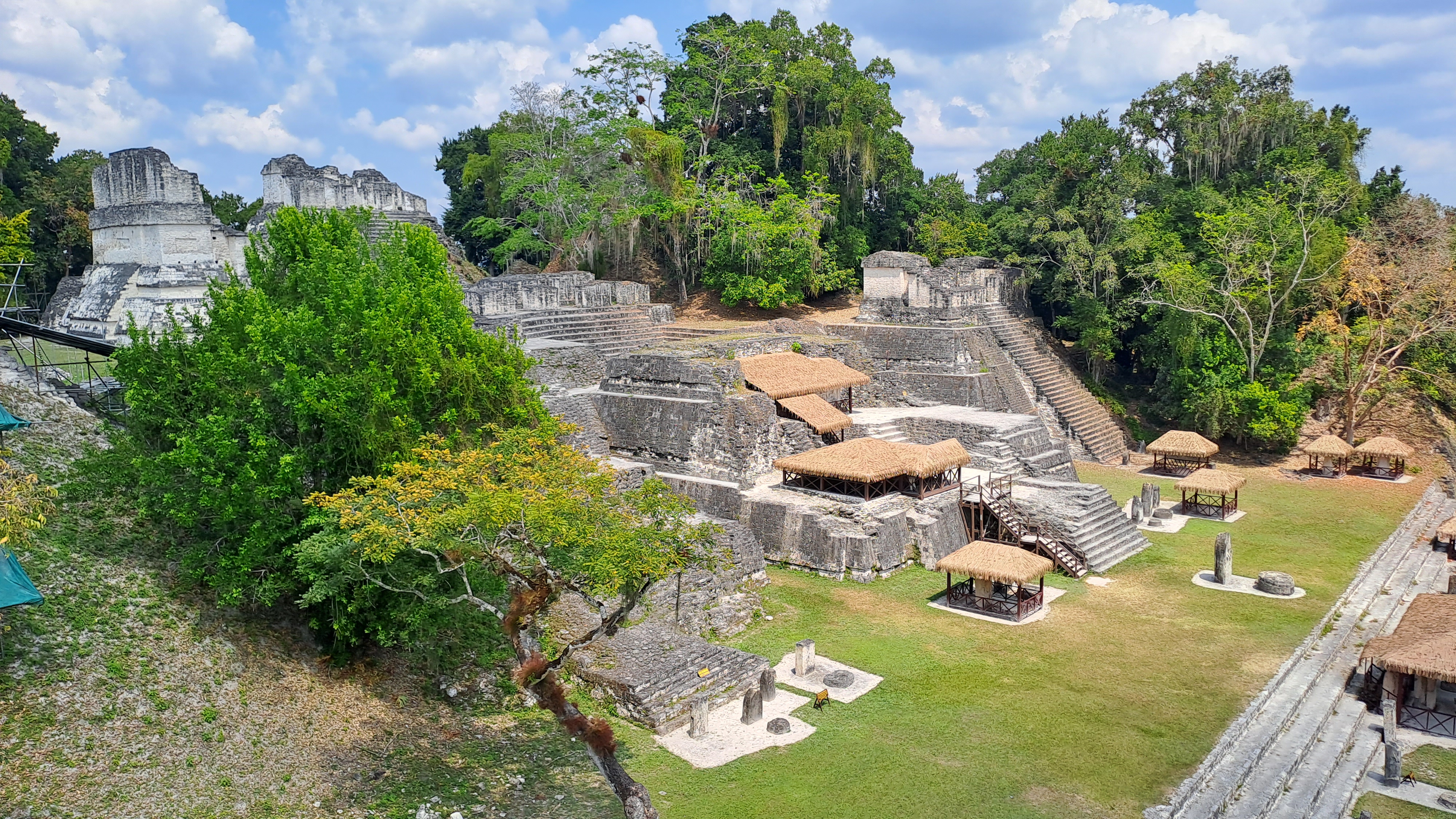
Tikal is the largest ancient Mayan city found in the north of Guatemala. If you are in Guatemala, it is one of the must-see places to visit.

We decided to spend two days in Tikal and two days in Flores which is a pretty town situated about 70kms southwest of Tikal. Many people fly or bus into Flores, then take a day trip to Tikal. We wanted to be in Tikal for the sunrise and to experience staying in part of the jungle, where you can hear all the animals sounds early in the morning and sometimes even late at night.

We left the Rio for Flores on Monday morning (13 March) by bus – or a minivan. It was hot! We left at 11.00am only arriving in Flores after 4.00pm. There are major road works taking place along the way. We knew once we arrived in Flores, we would have to find our way to Tikal, as the hotel we had booked to stay in, was in the actual National Park, about 100 metres from the entrance to the Mayan

temples. We found a taxi who would take us to Tikal. The drive was slow and tiring as the driver insisted on driving according to the minimum speed limit, but I suppose that is better than not arriving at all. We eventually arrived at our hotel – Hotel Jaguar.

The hotel was comfortable but a bit behind the times with regards to technology and electricity. They used generators and batteries, so the electricity was only available at certain times of the day. From 9.00pm to 6.00am, there was no power, so even the ceiling fans couldn’t be switched on and it was hot and humid, even in the middle of the night. All part of the experience!

Mel standing outside
 our room at Hotel Jaguar.

We were glad we had chosen the hotel because we had arranged to go on a sunrise tour of the Mayan ruins which started at 4.00am on Tuesday 14 March.

We met up with our tour guide, Caesar who was originally from Guatemala but had spent many years in New York City, so he was fluent in English. He was quite entertaining too.

It was wonderful and quite spooky walking along the pathway in the jungle, in total darkness with the odd glint of moonlight when there was a break in the canopy of trees.

Tikal was discovered in 1848 by Coronel Modesto Mendez and Ambrosio Tut. There is also the story that it was first founded by Mr Wrigley of chewing gum fame. He had sent out workers to find and gather the resin from some trees found in the area, as part of the ingredients to make chewing gum. – chicle. A few of the workers saw some scary and exotic faces and stone carvings. These were

At the Grand Plaza with Templo 1/Grand Jaguar
in the background.

investigated which led to the finding of the Mayan temples in Tikal. 

The National Park was open to the public in 1955 and it was recognised as a site of ‘Humanity Heritage’ by UNESCO in 1979.

Tikal in Mayan means ‘in the lagoon’ but many still refer to it and know it as ‘the places of the spirit voices’ or the ‘place that whispers’. The Mayan civilisation dates from the year 800BC until 900AD.

Only 20% of the 65 km2 has been excavated due to finances and the complexity of the whole structures as Mother Nature has taken over and the roots of the trees have embedded themselves into the structures.

Here are two links explaining a bit about the Mayan civilisation:

Mayan Civilization: Calendar, Pyramids & Ruins- HISTORY - HISTORY

Tikal - Wikipedia

A view from the top of Temple 4.
During our sunrise tour, we climbed Temple 4 which is also known as the Two-headed Snake Temple. It is the tallest temple in Tikal and in all Mesoamerica. (A Land of Ancient Cultures

Mesoamerica is a region that spans from central Mexico to northern Costa Rica, where diverse cultures flourished for thousands of years.). It was built in 740AD and is 70 metres tall. It was the last temple to be built and stands majestically above and overlooking many of the other temples, that is why it was perfect to climb up and watch the sun rise in the east.


Sitting at the top of Temple 4
, - the very top is in the background.
The bird life in the area/jungle is prolific! Therefore, the sounds of the birds early in the morning is loud and raucous competing with the growl of the Howler monkeys. While on our tour with Caesar, we saw the beautiful and colourful toucan – the Keel billed toucan to be precise, lots of Black Vultures, Golden Oriole, Great Curassow, Oscillated Turkey, lots of green parrots, and the North Jacana which is like a Lilly trotter. We heard the Lineated woodpecker but couldn’t see him amongst the branches and leaves.


The howler monkeys are quite prolific in the area, and you would be alerted that they were close by, by the rustling and the falling of the leaves. We would look above us and sure enough, there they were eating, lounging or playing around, swinging between the branches using their tails or their long arms and legs.


Coatimundi feeding.
We came across a group of Coatimundi, on two separate occasions, feeding, oblivious to us as we walked past them. They have long tails which stand erect and a snout mouth/nose to smell the bugs
lurking in the ground (similar to meerkats).

Jaguar do lurk in the area along with wild pig but thankfully we didn’t encounter any while walking around the park, although Mel would have loved to have seen one. Not sure what he would have done if he had of seen one. We did eventually see one but sadly in a zoo – more later.


After our tour with Caesar which lasted until about 9.00am, we went back to our hotel for a bit of breakfast, then went out again to explore the park and temples on our own. We walked down every road possible and saw all of the temples, climbed up everyone we were allowed to climb. In total, we walked

over 21kms that day according to our watches.

We were able to go up Temple 2 in the Grand Plaza, Acropolis Central, Temple 6 and the Palace de las Acanaladuras.


All the temples were built in different time periods and by different rulers. The whole Mayan dynasty was based on a feudal system and the life expectancy was maximum of 30 years.  There is some speculation that the whole dynasty collapsed due to lack of water and when the people left, mother nature took over and covered the temples until they were discovered in 1848.


We left Tikal on Wednesday, 15 March and headed for the town of Flores. Flores is where most people stay when they want to see Tikal and the Mayan temples, or the ruins further north of Tikal, Uaxactun. It is a touristy town surrounded by the cool refreshing waters of Lake Peten Itza, which is where you will find many people enjoying a dip in the waters after a tiring day in Tikal.


Mel and I felt quite old as many of the people were actually backpackers. Anyway, we managed to see what we wanted to see and that was a jaguar. We don’t usually like going to zoos, only if we know that they are of an extremely high standard and the animals are looked after appropriately.


We had read about the Zoological Education Centre of San Miguel, so on Thursday morning, we took a water taxi across the lake to San Miguel. We then took a tuk tuk to the zoo.


It was quite distressing to see the animals in such small cages. The animals looked healthy and the cages were of a reasonable size (except the vultures cage) but the cages were not well maintained and everything looked tired and badly in need of a revamp.


We saw a jaguar – yes it was sleeping and had a very full tummy but it was sad to see that he wasn’t active and hardly had enough space to run, jump and play.


We walked around the zoo, across to the little island where there were wild pigs roaming and scavenging about.  When it was time to go back to the main island of Flores, we arranged for a water taxi to take us back. That was a lovely ride as we had a wonderful view of the island. Riding with us were two small swallow type birds. They looked grey but with the glint of the sun on them, their colour was a beautiful darkish blue. They would sit on the bow of the boat then fly out, along side the boat, whirling and twirling.  It was magical to watch and experience after seeing some of the wild birds in the zoo, looking frustrated as they couldn’t fly free.


Flores had plenty of restaurants to choose from and in fact we were spoilt for choice.


We left Flores on Friday 17 March. The bus left for the Rio Dulce at 6.00am and we were back at the boat by 12.00pm.


Our next adventure will be starting on Sunday 19 March when we travel to Antigua and Lake Atitlan in the south west of Guatemala.


Until next time, take care and enjoy whatever you are doing.

Bye for now.

Mel and Caryn

sv Passages


If you want to see where we currently are – press on the "Latest Location" link at the bottom left of the page. This may not be accurate and is dependent on sites with access to AIS (automatic identification system).

 Additional photos of Tikal.


 Additional photos of Flores.

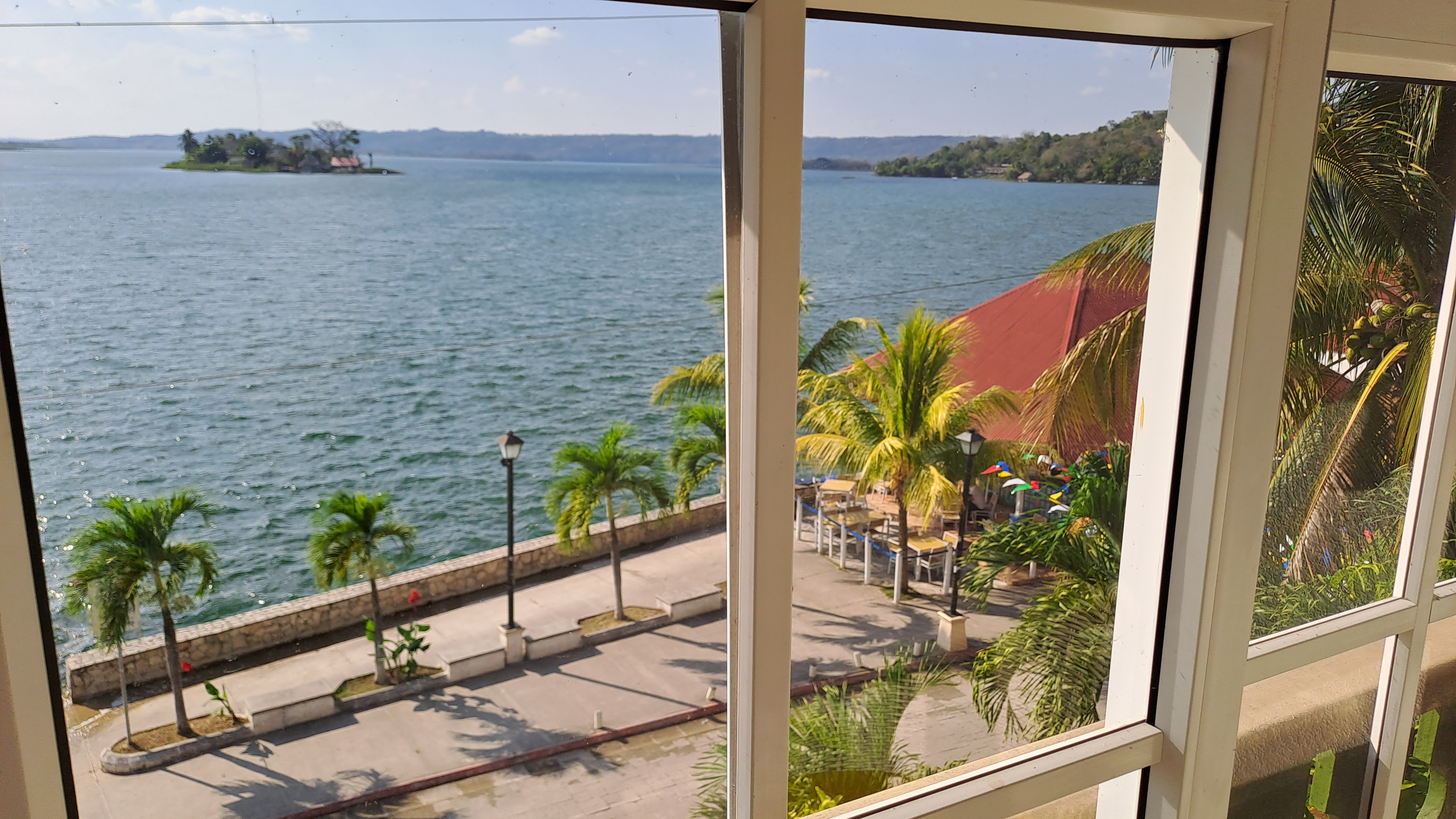
The view from our hotel window.

Mel enjoying the hotel pool.


Some of the colourful houses/buildings on Flores.


The Cathedral right at the top of the hill on the island of Flores.


Mel enjoying the boat ride back to the main island of Flores after our visit to the Zoo.


A spider monkey


The view from the zoo of Flores, with the Cathedral in the centre.


When we arrived back at the hotel, this is how our towels were folded. ๐Ÿ˜Š